Prevention in Romania runs at two speeds: Gen Z and everyone else
Bucharest, April 22, 2026 – For 25% of Romanians, the greatest obstacle to maintaining a healthy lifestyle is perceived cost. This is one of the findings of the study "Prevention as a Lifestyle in Romania 2026", recently conducted by ISRA Center Marketing Research at the request of Secom® Healthcare Group. The data comes against a difficult backdrop: Romania has one of the highest rates of avoidable mortality in the EU, ranking third for deaths preventable through public health policies and first for deaths treatable through timely medical intervention, according to the State of Health in the EU 2025 report
.
The study examines all lifestyle pillars (nutrition, physical activity, sleep, stress management, medical check-ups, avoidance of harmful substances, and social connection), with data compared to the previous study conducted in 2025 on a similar sample.
"When Romania ranks third in the European Union for preventable deaths, and 1 in 4 Romanians say that a healthy lifestyle is too expensive, we are no longer talking about individual preferences — we are talking about a public health emergency. The good news is that an active core of Romanians already exists — made up of Generation Z, athletes, and loyal supplement users — who demonstrate that integrated prevention works. Our task, as an industry and as a society, is to make it accessible to all Romanians," said Lucia Costea, co-founder & CEO of Secom® Healthcare Group.
Nutrition: the most visible leap of the year
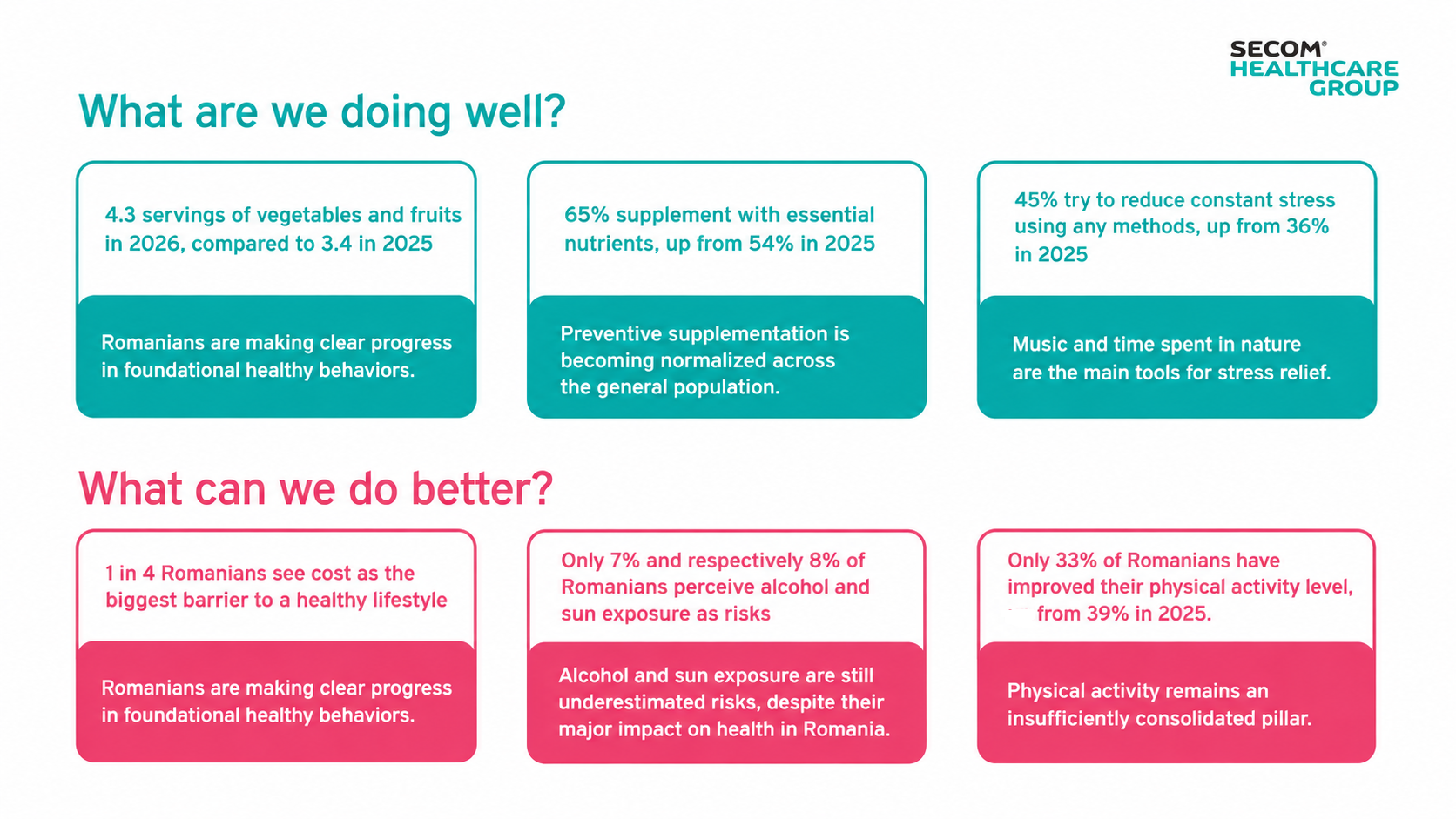
Average daily fruit and vegetable consumption rose from 3.4 servings/day in 2025 to 4.3 servings in 2026, approaching the WHO recommendation of 5 daily servings. The most striking development: the share of those consuming 5 or more servings per day has doubled, reaching nearly 41% this year. Generation Z leads clearly, averaging 5.1 servings/day — the only demographic segment meeting the WHO recommendation. Daily hydration increased from 1.8 to 2.3 liters/day, with Gen Z again leading at 2.9 liters/day. The share of those consuming over 2 liters daily rose from 12.4% in 2025 to 20.3% this year.
More than 1 in 3 Romanians (36%) actively sought healthier alternatives to processed snacks in the past 6 months — a 6-percentage point increase compared to 2025. The top alternatives chosen were fresh fruits and vegetables (41.2%), natural snacks with simple ingredients (24.1%), seeds, nuts, and dried fruits (23.2%), and dairy products (8.3%).
Supplements becoming a prevention tool
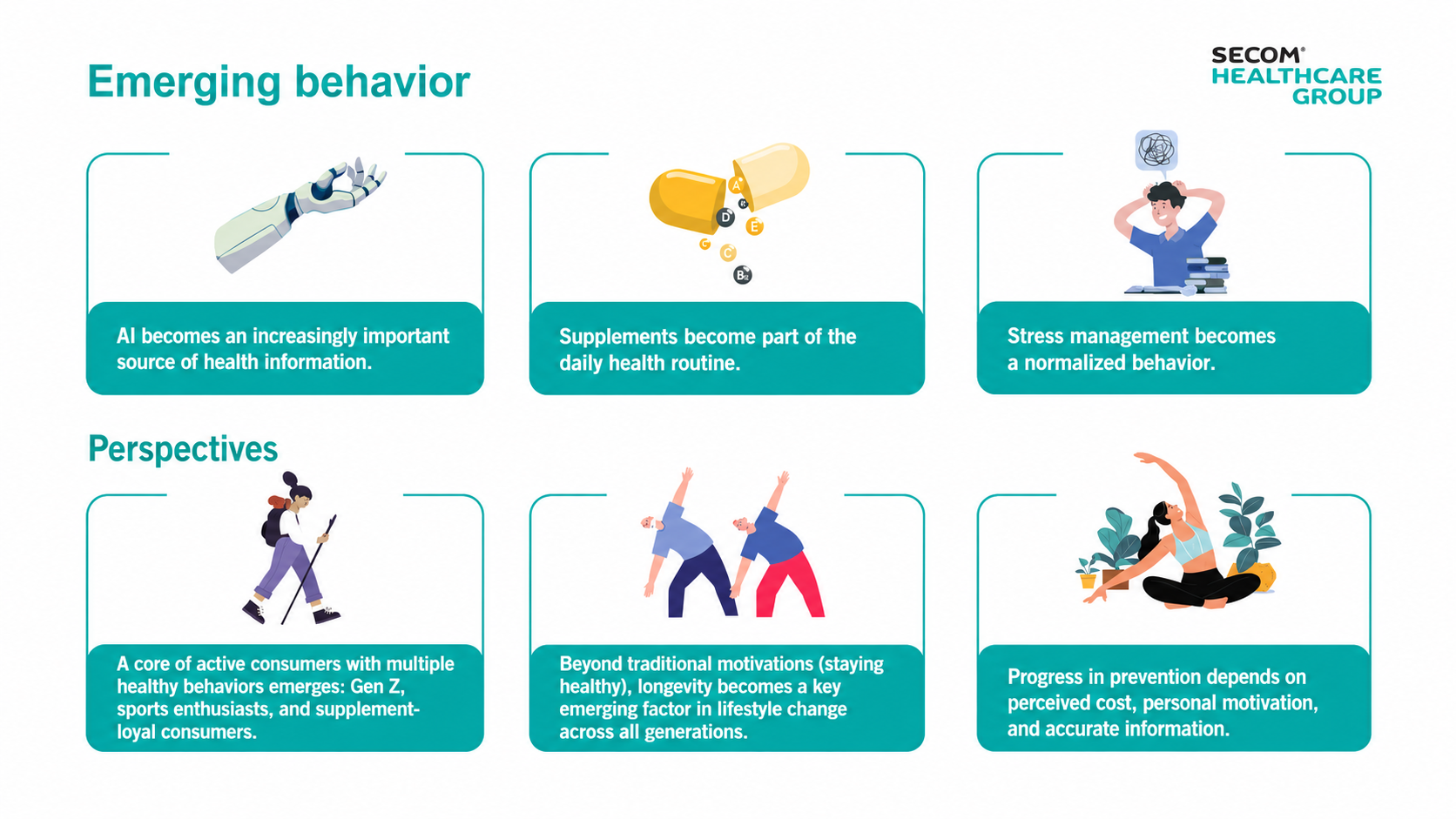
A growing number of Romanians are using vitamins, minerals, and supplements with a preventive purpose: 65% of users report using them to avoid health problems, up from 54% in 2025.
Monthly usage increased from 33% to 38%, a sign that preventive supplementation is becoming normalized among the urban population. Data from medical tests supports this trend: among those who had blood work done in the past year, 39% were diagnosed with vitamin D3 deficiency and 38% with magnesium deficiency — the two leading deficiencies identified.
Physical activity: the only pillar where intent is eroding
Approximately 50% of Romanians exercise at least twice a week, in line with the WHO recommendation, but the average session duration has dropped to 43 minutes (from 45 in 2025), falling below the approximately 75-minute benchmark derived from the WHO's 150-minute weekly recommendation. Moreover, the share of Romanians intending to improve their physical activity levels over the next 12 months fell from 47% to 41% — the only major pillar where stated intention is declining. Only 18% of respondents exercise daily or nearly daily, and these belong to the "active core": loyal supplement users (28%), Gen Z (26%), and men (25%).
Stress: a lighter burden
45% of Romanians report actively managing stress, up 9 percentage points from 2025 (36%). Preferred methods are accessible and cost-free: music (20%), walks in nature (18%), passive relaxation (13%), and physical activity (12.5%). Meditation remains marginal (9%). Once again, the "active core" dominates: 59% of competitive athletes, 55% of loyal supplement users, and 55% of Gen Z consistently manage stress.
Romanians are sleeping well
Average sleep duration remained stable at 7.1 hours in 2026, at the minimum level recommended by the National Institutes of Health (minimum 7 hours for adults). Behind this seemingly unchanged average lies a more balanced distribution: the share of those sleeping fewer than 6 hours dropped from 8.9% to 7.6%, while those sleeping 8 or more hours increased from 33.4% to 37.1% cumulatively. The segments sleeping the most again coincide with the health "active core": Generation Z (7.5 hours on average) and competitive athletes (7.4 hours) confirming that prioritizing sleep is part of a broader health identity, not an isolated behavior.
Risk perception: alcohol and sun exposure massively underestimated
Romanians feel most exposed to air pollution (32.1% nationally, rising to 47% in Bucharest) and active smoking (31.3%). At the opposite end, only 7% consider themselves exposed to alcohol-related risks and only 8% to solar radiation — even though both represent major health risk factors in Romania.
Rate of preventive medical check-ups remains stable
62.3% of Romanians have an annual preventive medical check-up (compared to 64.3% in 2025), and 65.2% had blood tests done in the past year. Competitive athletes (52%) and loyal supplement users (42%) remain the most proactive. Differences across segments are significant: 13% of Gen Z youth and 11% of low-income individuals have never had blood tests — an indicator of both access barriers and health culture gaps.
Social connections: an underused resource
Only 39% of Romanians say they seek emotional support in difficult moments. They rely most on family (58%) and partners (53%), while only 24% turn to friends. Gen Z and athletes are more open to seeking help, placing them once again among the segments with more advanced health behaviors.
AI: an increasingly popular prevention guide
A decline in the use of websites (from 36% in 2025 to 26% in 2026), pharmaceutical websites (from 11% to 7%), and influencers (from 8% to 6%) as sources of prevention information points to growing fragmentation and distrust in traditional digital health content. However, a significant rise in Artificial Intelligence platforms (from 9% in 2025 to 16% in 2026) stands out — particularly among those aged 28 to 37, i.e. Millennials (22%) reflecting a generational shift in information-seeking behavior. This may reshape how patients arrive at consultations, how products are discovered, and how health knowledge is formed.
"The study shows that the way we seek health information is changing rapidly: the share of AI platforms has nearly doubled in the past year, from 9% to 16%. In this context, another finding of the study becomes essential: people with more healthy behaviors seek information significantly more often from professionals — 45.1% from their family physician, compared to just 20% among those with fewer healthy routines; 38.6% vs. 13% from specialist physicians; 25.6% vs. 11.3% from pharmacists. Real prevention is built through informed choices, properly understood and consistently applied — and those who have integrated it into their lives don't stop at self-research; they seek to validate it as well," stated Prof. Dr. Radu Țincu, Primary Care Physician in Intensive Care and Toxicology Expert.
Cost: the main barrier to a healthier lifestyle
For 25% of Romanians, the greatest obstacle to maintaining a healthy lifestyle is perceived cost, followed by lack of time (24%), fatigue (23%), and daily stress (23%). Paradoxically, personal motivation remains the primary driver of change, cited by 59% of those who have made progress. A notable behavioral shift is also emerging: 26% of those who made changes in the past 12 months did so to stay young and active for longer (up from 23% in 2025), in other words, longevity is becoming an emerging motivation, in line with international trends.
"The study shows a real shift in how young people relate to prevention. Gen Z consumes an average of 5.1 servings of fruits and vegetables per day — above the general average; 55% actively manage their stress, and sleep reaches 7.5 hours per night. Even on physical activity we see positive signals: their sessions exceed 51 minutes, compared to the general average of 43. These are encouraging signs. At the same time, however, 13% of Gen Z youth have never had blood tests — which shows us that while they have good preventive behaviors, not all pillars are equally integrated into their lifestyle," stated Dr. Raluca Ghionaru, President of the Romanian Association for Pediatric Education in Family Medicine (AREPMF).
Conclusions
Prevention is advancing in Romania, but unevenly. Romanians are making clear progress in the more accessible areas — nutrition, hydration, stress management, and preventive supplementation — and an active core of consumers (Gen Z, athletes, loyal supplement users) is emerging, simultaneously accumulating multiple healthy behaviors.
At the same time, physical activity remains the most fragile pillar — the only one where both behavior and stated intention are declining — and perceived cost remains the greatest barrier for 1 in 4 Romanians, turning prevention into a segment privilege rather than a national norm.
Alcohol (7%) and sun exposure (8%) continue to be underestimated as risk factors, in contrast to pollution (32%) and smoking (31%). Against the backdrop of shifting information sources — with AI platforms nearly doubling their share in one year and traditional digital channels declining — the challenge for the years ahead is transforming isolated behaviors into sustainable routines that are financially accessible and grounded in accurate information and scientific evidence.
*Methodology
The study was conducted using the CAWI methodology (online interviews) between February 20–25, 2026, on a nationally representative urban sample of 1,000 respondents aged 18 to 65 (54.5% women and 45.5% men), structured across four age groups: Generation Z (12.9%), Millennials (35.3%), Generation X (33.9%), and Baby Boomers (17.9%). The margin of error is ±3%, at a 95% confidence level.
About Secom® Healthcare Group
Secom® Healthcare Group is an authority leader in integrative medicine solutions and, over 22 years of activity, has built a solid reputation in the import and distribution of a premium health product portfolio.
Secom® contributes to improving people's health and wellbeing through an integrated ecosystem built with responsibility and ethics, encompassing scientifically grounded solutions: premium food supplements, functional foods, and a proprietary network of 22 stores offering professional, personalized consultancy services.
Secom® has the highest retention rate in the food supplements category (66%)* and is perceived as the quality leader by approximately 40% of specialists within the medical community**.
More information about the organization is available at www.secom-healthcare.com.
* According to the brand awareness study conducted by AHA Moments, October 2025
**According to the IQVIA Recall Test study, October 2025